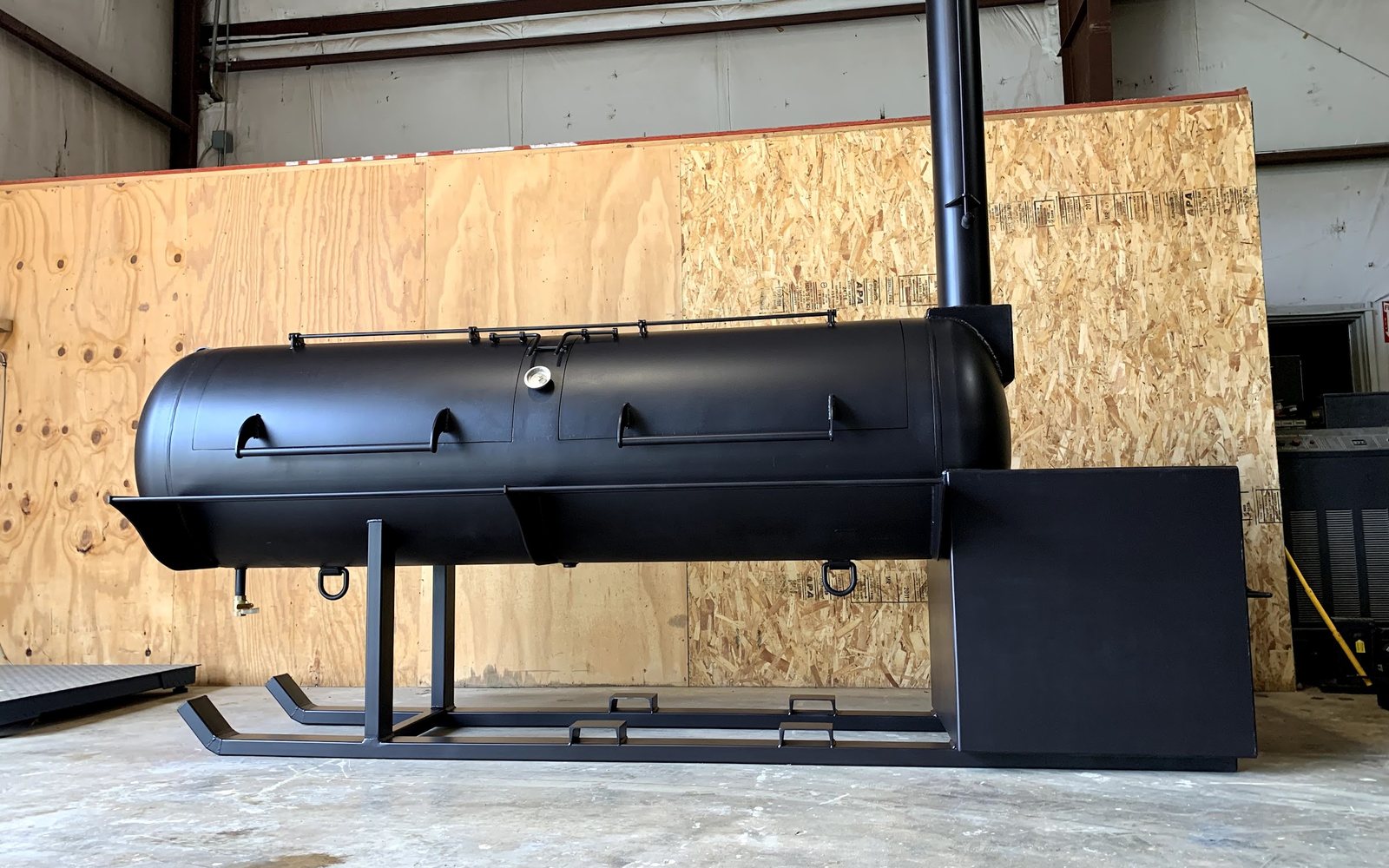
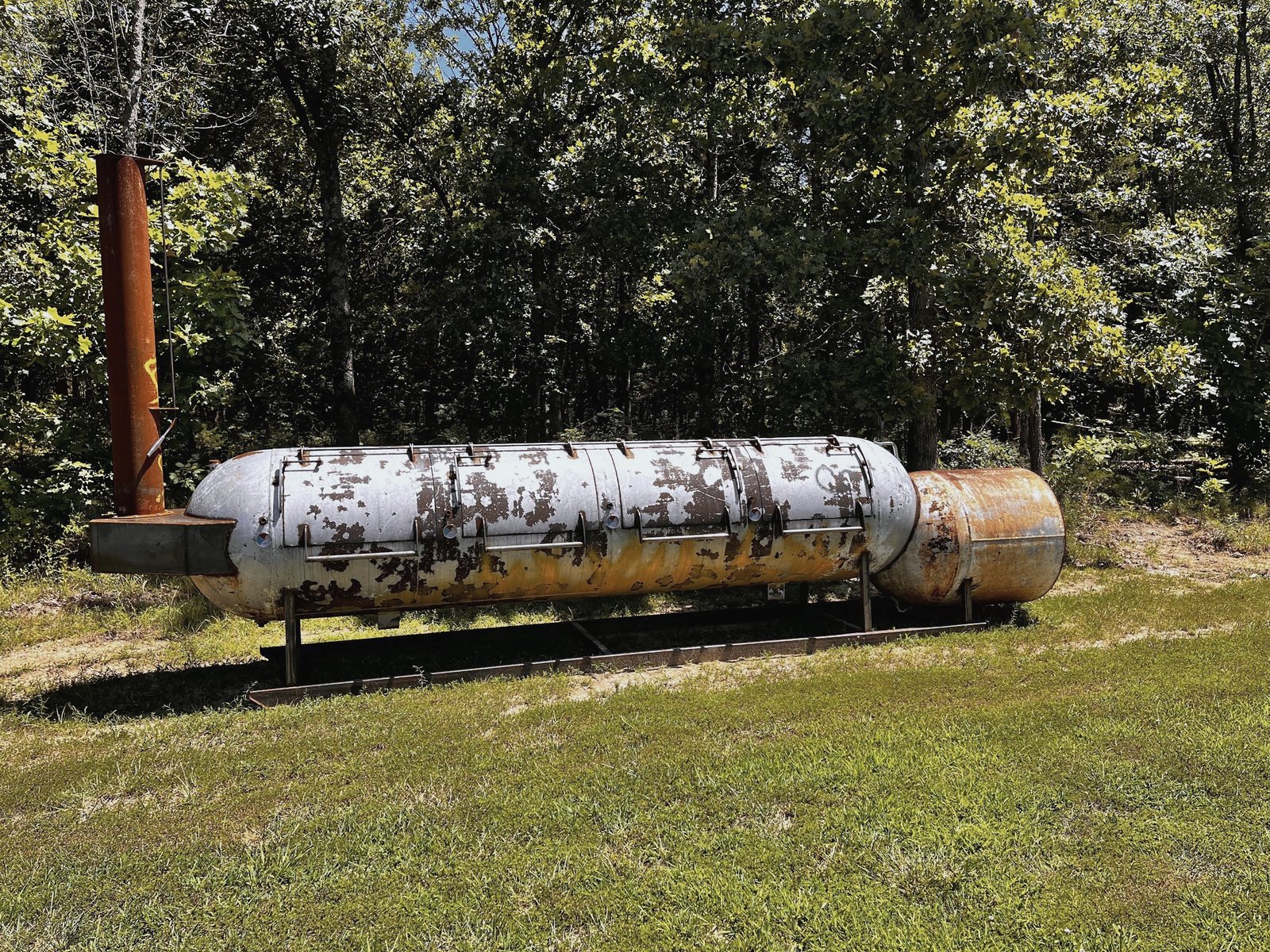
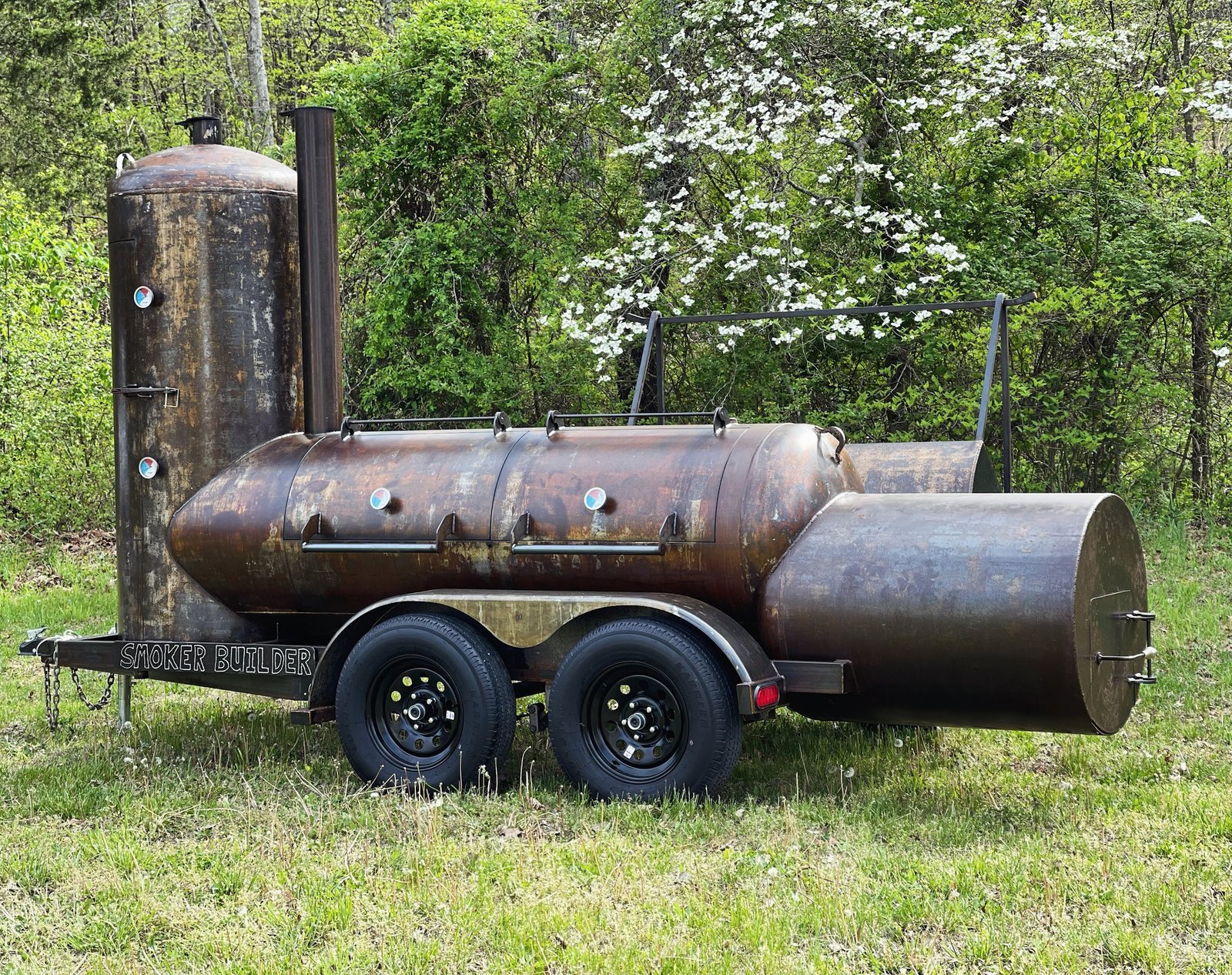

An offset smoker puts the fire off to the side, in its own firebox, instead of under the food. The heat and smoke travel across the cook chamber and leave out a stack on the other end.
That's where the name comes from. The fire is offset away from underneath the cooking area.
Below is how the air moves through one, what each part does, how big the parts should be, and how an offset gets built, in the order you'd build it.
Rather start from a drawing? My plan sets are drawn by cook chamber type and size. See the offset smoker plans
Key facts from Frank Cox, The BBQ Pit Engineer
- An offset has the fire in its own firebox to the side. Heat and smoke cross the cook chamber and leave out the stack on the far end.
- No fan. The stack's draw pulls fresh air in at the firebox.
- Firebox: about 30% of the cook chamber's volume.
- Throat area = firebox volume in cubic inches × 0.008, in square inches.
- Stack: at least half the cook chamber's length, never under 33".
- Air intake = firebox volume × 0.003, in square inches.
- Most offsets run in zones and can be hotter toward the firebox end. A buoyant, balanced design moves a calm, low velocity, high volume air mass that cooks even.
- For a first build, I recommend a straight offset.
Last updated November 27, 2026
What is an offset smoker?
It's a smoker with the fire in a separate box mounted to the side of the cook chamber. The food never sits over the fire. The heat and smoke come through an opening called the throat, move down the chamber over the food, and go out the stack.
It burns real wood, and it runs on natural draft. There's no fan and no auger. The pit itself moves the air.
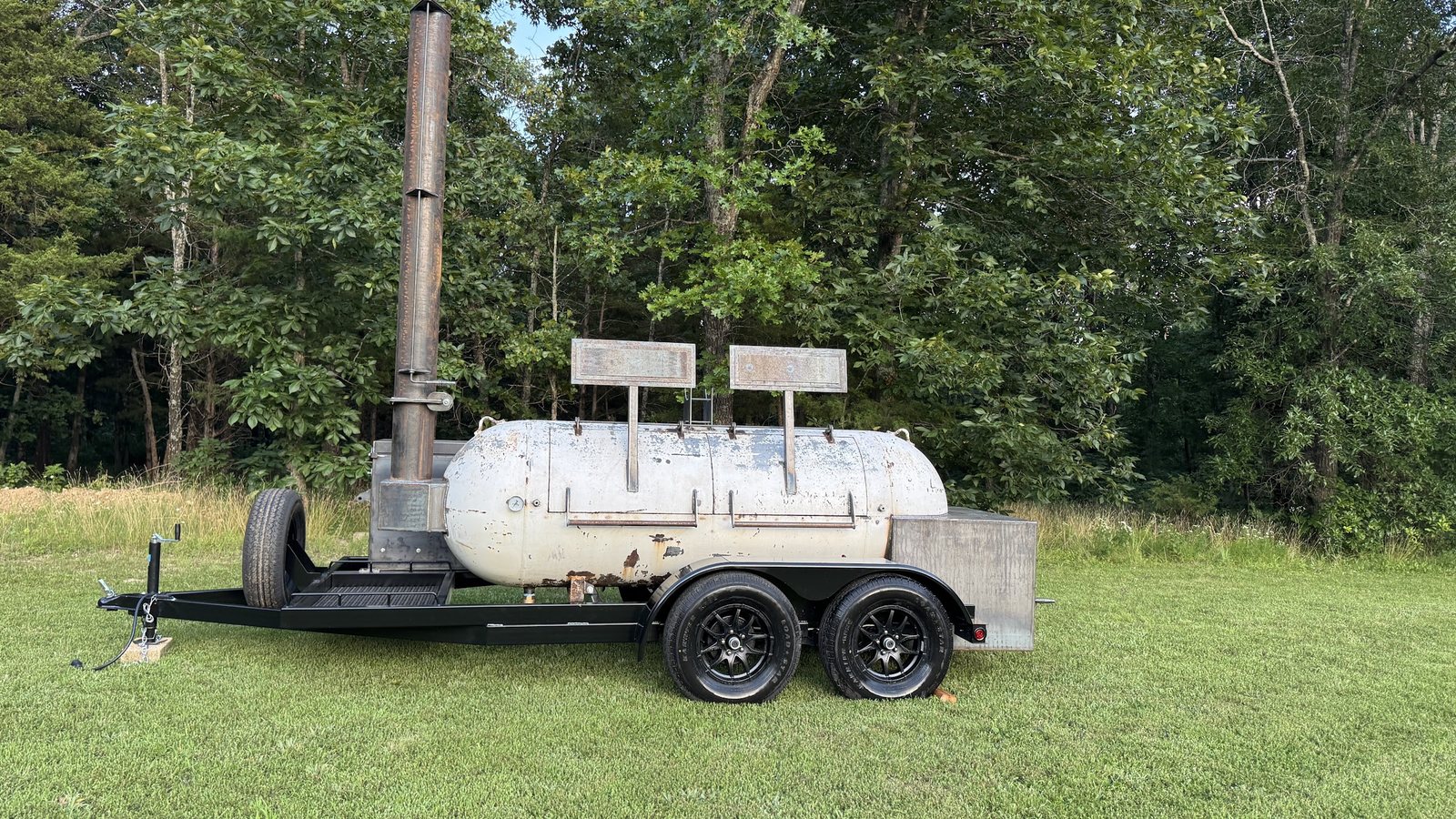
How does an offset smoker work?
Hot air rises, and the stack pulls. That's the whole engine. Here's the path the air takes, firebox to stack:
- Air comes in low through the intake at the firebox.
- It feeds the fire, and the fire makes heat and smoke.
- The heat and smoke leave the firebox through the throat at the top of the box.
- A scoop baffle at the throat turns that air up.
- The heat fills the cook chamber from the top down. Once it builds down to the height of the stack outlet, the draft sets in and the air moves the length of the chamber, over the food.
- It gathers in the collector box and leaves up the stack. That draw is what keeps pulling fresh air in at the firebox.
On a properly balanced pit there's one more thing going on. A small amount of air rolls back the other way, under the grate, from the stack end about halfway back toward the firebox. I call that undertow. It's what cooks the bottom of the food and helps the color.
It comes from back pressure building inside the cook chamber. Loosely, about 70% of the air goes out the stack and about 30% is retained. It only happens on a balanced design.
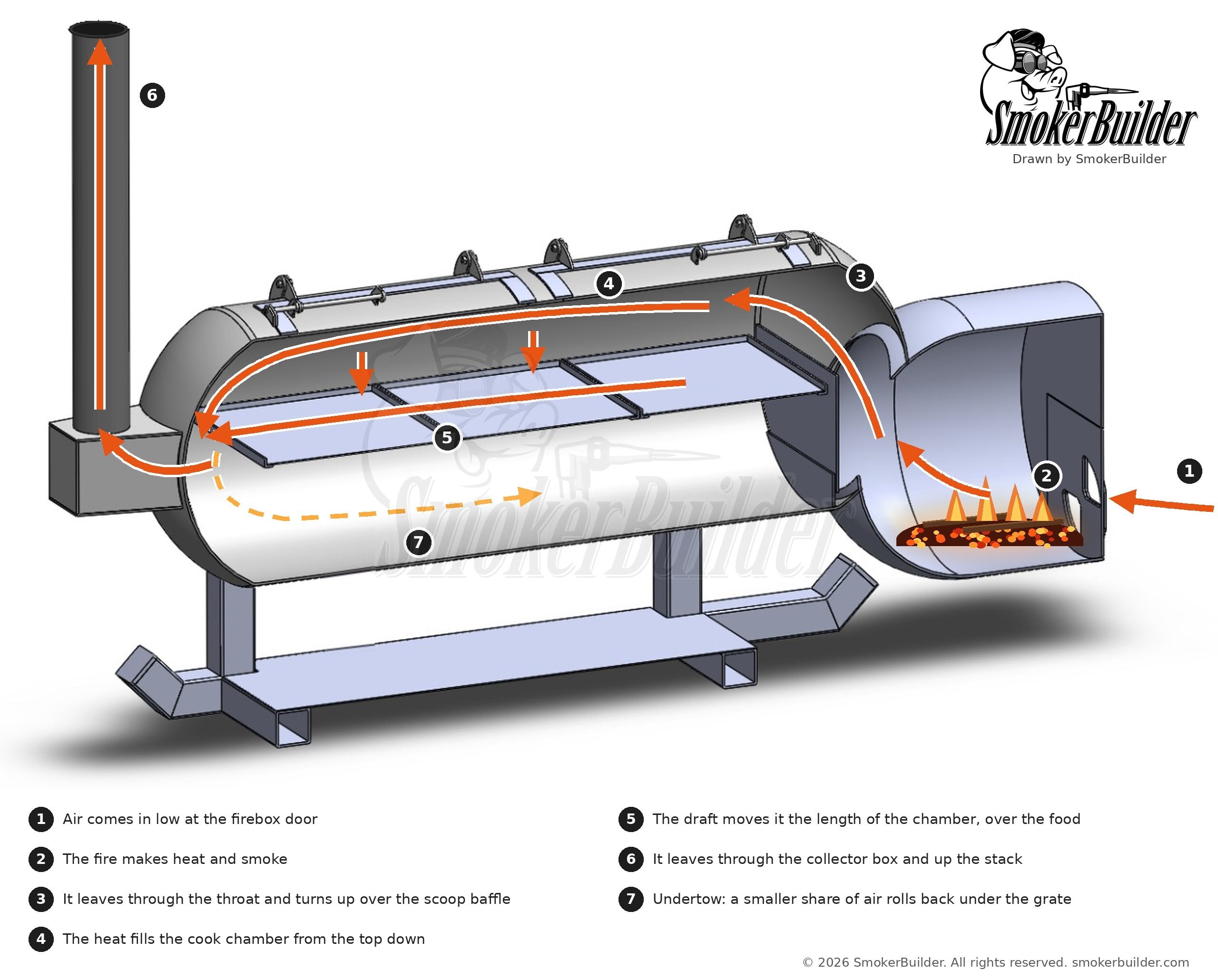
Tap the diagram to open it full size
On a traditional offset the stack is on the far end, like the drawing. On a reverse flow it moves back to the firebox end. More on that below.
What are the parts of an offset smoker?
- Firebox: the box on the side that holds the fire. It's sized by volume, about 30% of the cook chamber.
- Throat: the opening between the firebox and the cook chamber. It's sized to pass all the air without speeding it up, so it isn't the choke point.
- Cook chamber: the body of the pit, where the food sits and the heat and smoke move through.
- Scoop baffle: one plate at the throat that kicks the incoming air up. A scoop baffle and a vertical baffle are the same thing.
- Collector box: gathers the air at the far end and feeds it into the stack. Make it at least as tall as the stack's diameter, and no less than 1.5 times the stack diameter wide. Width doesn't matter as much as people think. Undersizing it is the real problem.
- Stack: where the air leaves, and what creates the draw.
- Intake: the adjustable air inlet on the firebox.
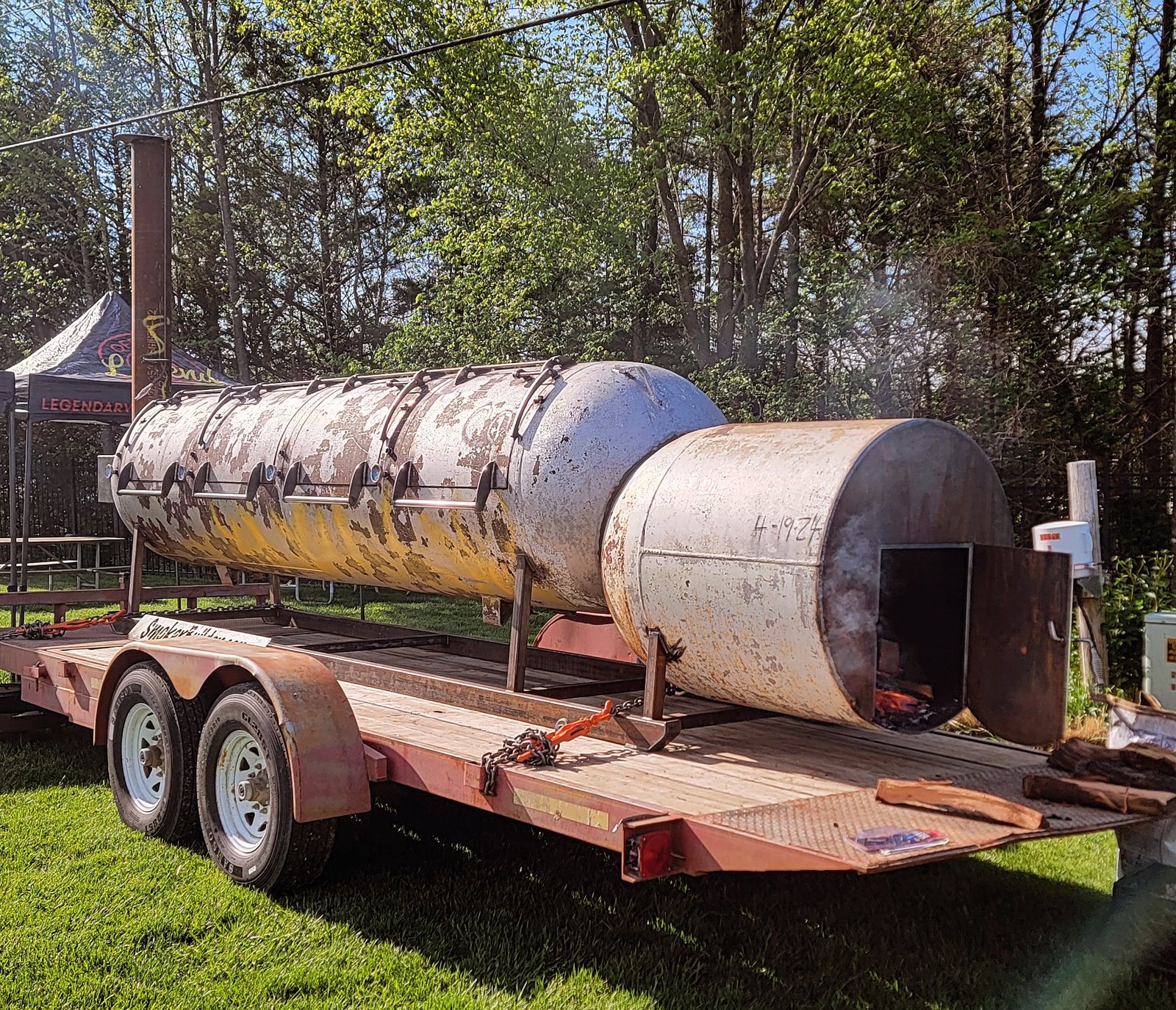
Some offsets use tuning plates or a full reverse flow plate under the grate instead of a scoop. All three are covered in Smoker Baffle Plates.
Does one end of an offset run hotter than the other?
On most offsets the temperature runs in zones, and it can be hotter toward the firebox end. That happens when the pit isn't designed to be buoyant and balanced.
A pit with too small a firebox runs high velocity, low volume air. I call that a high velocity, low volume offset. The air comes through the throat like you put your thumb over a water hose.
A buoyant, balanced offset runs the other way: low velocity, high volume air. It's a calm, tempered air mass, and it cooks evenly. My numbers and design methods are built for a buoyant, balanced pit.
The scoop is a vertical deflector right at the throat. The air coming out of the firebox already wants to rise, and the scoop works with that and sends it up, so it doesn't speed the air up or build back pressure.
A downward deflector plate pushes the air mass farther out into the cook chamber. But the air still wants to go up, like nature intended. So all it does is push the original problem farther out into the chamber.
Going up, across the top and back down, the air picks up a little turbulence. That slows the whole air mass and makes it lazy as it comes back across the grate. That's what sets up the undertow.
How big should the firebox, throat and stack be on an offset?
Everything is sized off the cook chamber, in this order:
- Firebox: about 30% of the cook chamber's volume.
- Throat: firebox volume in cubic inches × 0.008 = square inches of opening. Size up, never down.
- Stack: at least half the cook chamber's length, and never under 33". The diameter goes up with the size of the chamber.
- Intake: firebox volume × 0.003 = square inches of intake.
Worked examples for a 250 and a 500 gallon are in Offset Smoker Sizing. The firebox itself is covered in Offset Smoker Firebox Design.
Does the shape of the cook chamber matter?
No. It's a buoyant system. Round, square or some other shape cooks the same once the volume is right.
Same with the firebox. It's sized by volume, so any shape that hits the volume works.
Offset or reverse flow: which should you build?
A traditional offset has no full-length plate under the grate. Most of them run in zones and can be hotter toward the firebox end, unless the pit is designed to be buoyant and balanced.
A reverse flow has one solid plate under the grate that sends the heat to the far end and back. That evens out the temperature and moves the stack to the firebox end. It's more steel and more welding.
For a first build, I recommend a straight offset. The full comparison is in Smoker Designs.
How a reverse flow works and how to build one: Reverse Flow Smoker.
Is an offset smoker worth it? Offset vs pellet
The main difference is the fuel.
Pellets have to be very refined, and held to a certain moisture content, to stay together as a pellet. That manufacturing process takes out a lot of what the wood naturally has in it, and that's what produces the flavor and texture an offset can get.
The second difference is the airflow. A pellet smoker lights its fire with an electric ignitor. Because of the way those ignitors are designed, a pellet smoker can't have back pressure built in from the stack damper. Close the damper down and the ignitor can overheat and short out internally, and then it won't light anymore.
So the air moves through a pellet smoker's cook chamber very quickly. That cuts down how long the smoke stays in the chamber, which means lighter smoke flavor, sometimes none, and less bark than an offset can get. In my own testing, pellet burners move about 130 cubic feet of air for every pound of pellets burned. That's the baseline I use for pellet burner design.
A lot of people add wood chunks or charcoal pellets to a pellet smoker to get around this. Those cause other problems of their own.
An offset burns real split wood on natural draft, with real steel mass holding the heat. What you take on is a pit designed around a live wood fire, a lot of steel weight (with an axle and trailer to match), and the work of building it.
What is an offset smoker built from?
The cook chamber is a used propane or air tank, large diameter pipe, or rolled plate. 1/4" plate is the default. A tank wall in the 3/16" to 1/4" range is a good buy.
That's why my plans are laid out by cook chamber type and size. You aren't limited to a propane tank. If you go with a tank, start here: Buying a Used Propane Tank for a Smoker.
How is an offset smoker built?
In this order:
- Start with a purged, depressurized tank.
- Level it and lay out your reference lines off top dead center and the 3:00 line.
- Cut the firebox opening, then the collector and stack opening.
- Cut the doors last.
- Fit up and tack, check it, then weld it out.
- Finish the cook chamber and baffle before you start the trailer.
- Build the trailer, mount the pit, then finish it.
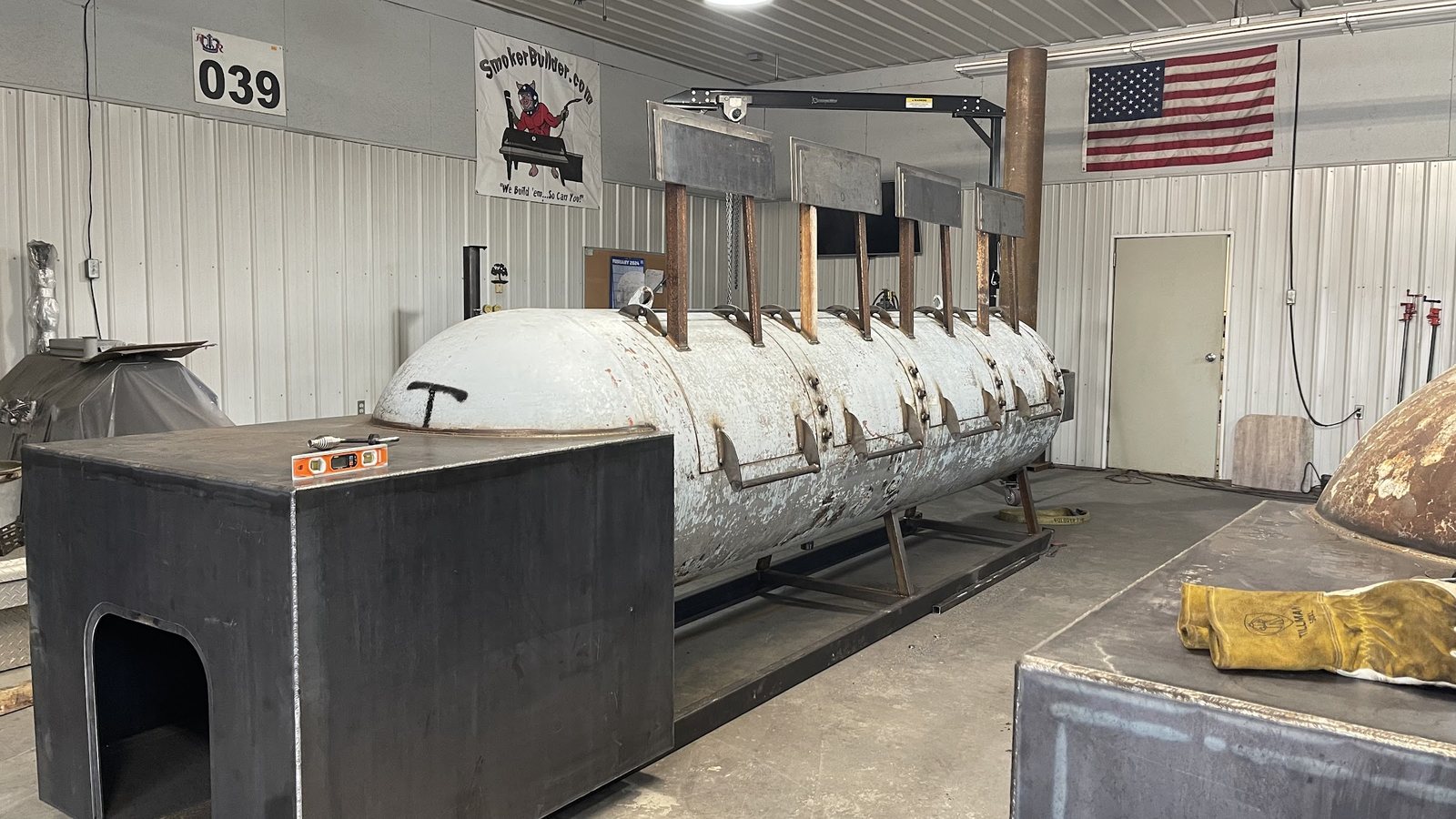
The cutting order matters. Cut the firebox and stack openings before the doors so the shell doesn't twist when the steel's internal stresses let go. If a door springs about 3/16" after it's cut, that's fine. It doesn't need correcting.
Tack it, check it, then weld it. You shouldn't have to grind to correct too many things. Grinding is cleanup.
On the cook chamber doors, lay them out off top dead center and check them square with a 3-4-5 triangle. Cut them with the plasma dragged against a straight edge. A 1/2" solid rod pin through a 1.5" by 1/8" strap makes a good hinge.
The full walkthrough is in How to Build a Smoker.
What tools do you need to build an offset smoker?
A 200+ amp welder, ideally a multi-process machine (start on MIG), a plasma cutter and an angle grinder. More on picking a machine: What Welder Do You Need to Build a Smoker?
What design mistakes make an offset draw badly?
If smoke keeps rolling out of the firebox door, and your cook chamber is hard to get up to cooking temperature or cooks very uneven, that's a draft problem built into the pit. Look at these:
- A stack that's too small, in diameter or length.
- A throat opening that's too small.
- On a reverse flow, a baffle gap cut too tight.
Soot can also close down a stack that was undersized to begin with, which goes back to the diameter you picked. Smoke out of the cook chamber door isn't a real problem.
What build mistakes matter most on an offset?
- Cutting the doors first. The shell twists.
- Undersizing the axle and trailer. The steel weight is locked in at design time.
- Shopping by gallons for cooking room. Size by the grate.
Where to go from here
Start with the numbers: Offset Smoker Sizing. Then the two parts that make or break the draw: Offset Smoker Firebox Design and Smoker Baffle Plates.
If this is your first build, you can follow a full 500 gallon offset build inside SmokerBuilderU step by step, and bring your questions to the live Q&A every Wednesday night at 7pm Central.
Join SmokerBuilderU
If you'd rather start from a drawing, every plan set I've drawn is at smokerplans.net, laid out by cook chamber type and size.
See the offset smoker plans
PS. If you only remember one number, make it the firebox. Get that right and the rest is sized off it.
Questions builders ask
What is an offset smoker?
A smoker with the fire in a separate firebox mounted to the side of the cook chamber, instead of under the food. Heat and smoke cross the cook chamber and leave out a stack on the far end.
How does an offset smoker work?
On natural draft. Air comes in at the firebox intake, feeds the fire, and the heat and smoke go through the throat, across the cook chamber and out the stack. The stack's draw keeps pulling fresh air in. There's no fan.
Why is it called an offset smoker?
Because the fire is offset away from underneath the cooking area, in its own box on the side.
Which end of an offset smoker is hotter?
Most offsets run in zones and can be hotter toward the firebox end. That happens when the pit isn't designed to be buoyant and balanced. A balanced offset moves a calm, low velocity, high volume air mass that cooks evenly.
How big should the firebox be on an offset smoker?
About 30% of the cook chamber's volume. Size the throat at firebox volume in cubic inches × 0.008 for square inches of opening.
Is an offset or a reverse flow better for a first build?
A straight offset. It's the simpler build, with less steel and less welding than a reverse flow.
Is an offset smoker better than a pellet smoker?
The main difference is the fuel and the airflow. Pellets are refined, which takes out a lot of what gives an offset its flavor and texture. A pellet smoker's ignitor also means it can't have back pressure built in from the stack damper, so air moves through fast and the smoke doesn't stay long. That means lighter smoke flavor and less bark than an offset can get.
What is undertow in an offset smoker?
A small amount of air that rolls back the other way under the grate, from the stack end about halfway toward the firebox. It cooks the bottom of the food and helps the color. It comes from back pressure inside the cook chamber, with loosely 70% of the air going out the stack and 30% retained, and it only happens on a properly balanced design.
Does the shape of the cook chamber matter on an offset?
No. It's a buoyant system, so round, square or another shape cooks the same once the volume is right.

About the author. Frank Cox, The BBQ Pit Engineer, founded SmokerBuilder in 2010 after a career in refrigeration, HVAC and food equipment that now spans 32 years. By his best estimate, he has built more than 1,000 pits in total and drawn more than 240 plan sets. His plans are at smokerplans.net, and he teaches the build step by step inside SmokerBuilderU.