
Before you buy steel, decide how you want the pit to cook.
The design follows from that.
The way a pit cooks gets welded in when you build it. The baffle, where the stack goes, where the firebox sits… none of that changes later without major fabrication and rework.
So here are the smoker designs I'd actually look at for a homemade offset, how the heat moves through each one, and what you give up with each.
Start with one question
Do you want even heat from one end of the chamber to the other? Or are you fine working around a hot end and a cool end?
If you mostly cook one or two big cuts at a time and want the most smoke into them, I lean offset. If you fill the whole chamber with a lot of same-size pieces that all need to finish together, reverse flow's even temps make that easier.
Keep your answer in mind as you read the rest.
Traditional offset
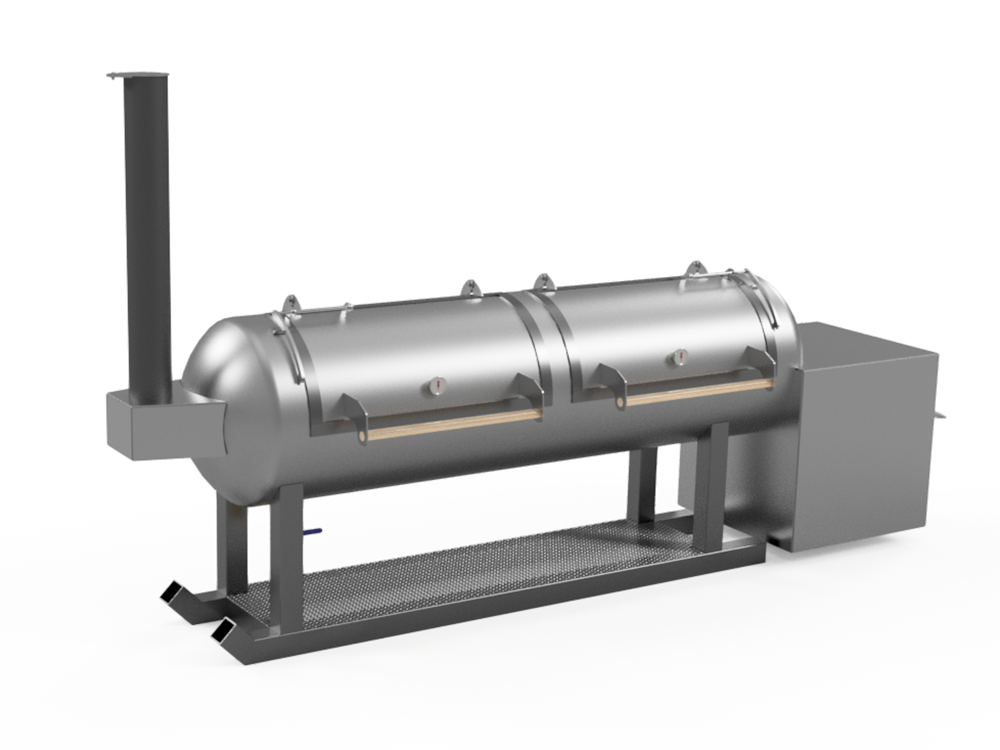
Firebox on one end, stack on the other.
The heat comes in from the firebox side and fills the chamber from the top down. It stacks up until it gets to the stack outlet, and that's when the draft gets going.
So the temperature runs different from one end of the chamber to the other. Hotter toward the firebox, cooler at the far end. That's by design. You cook around the zones.
- Good at: it's the simpler build, and you get a strong wood smoke flavor.
- Tradeoff: uneven temps end to end.
- Suits: a first build, and anybody who wants the classic stick burner and doesn't need every rack the same.
Reverse flow
The stack moves to the firebox end, and a solid baffle plate gets welded in under the grate.
The heat runs the length of the chamber under that plate, turns around at the far end and comes back over the top before it goes out the stack. That out-and-back path is what evens the temps out end to end.
- Good at: even temps end to end, and it's a much moister environment in there.
- Tradeoff: more steel and more welding. The baffle is in there for good and has to be cleaned underneath. And it can run too clean for my taste.
- Suits: somebody filling the whole chamber with same-size pieces who'd rather have even racks than the most smoke flavor.
One thing about the stack on a reverse flow. I would completely not recommend moving your smokestack down. The air cools off too much and condenses, and I've actually seen it completely plug a smokestack before. Keep it up at the top and get that air out of there as fast as you can.
Vertical baffle with a scoop
Vertical-baffle offsets with a scoop at the throat… that's my favorite right now.
It's still an offset. Firebox on one end, stack on the other. The difference is at the throat.
Without it, the hot air leaves the firebox and blasts straight across at grate level, right into the first piece of meat. The scoop turns that air up the second it comes out of the firebox. The air rises, rolls across the top, and that turn makes it a little more lazy as it comes back across the bottom rack. That's the undertow you want.
- Good at: it protects the meat on the firebox end, makes that hot end usable, and keeps the flavor of an offset.
- Tradeoff: with a vertical baffle the top rack runs at least 100 degrees hotter than everything else. If you need two even levels for production cooking, I'd point you to a reverse flow instead.
- Suits: a single-level offset where flavor matters.
Tuning plates and hybrids
Tuning plates are basically the reverse flow baffle plate cut up into 6" to 12" sections. Instead of one solid plate, you slide them along under the grate to open or close the spaces between them. Closer together at the firebox end so less air comes up through, farther apart as you move away from the firebox so more comes through. Tuned like a guitar.
That design is becoming outdated as popularity grows for the traditional offset designs.
A hybrid is a reverse flow and offset combo. Two stacks, and cut-up tuning plates in place of one solid baffle, so you can run it more than one way. It's flexible. It's also more complicated to build and easier to get wrong. I'd save it for a second build.
What doesn't change how it cooks
Some things people worry about don't matter as much as they think.
The shape of the chamber. A propane tank, a section of pipe, plate rolled into a cylinder, an octagon, a rectangle. They all cook the same. A smoker runs on draft, and draft comes from the height of the stack and how hot the air is, not the shape of the box. So build the shape you can actually make.
To be fair about it, a flat-sided box has a little more wall for the same volume. A square has about 13% more than round, an octagon about 3%, a 2-to-1 rectangle about 20%. That means a touch more fuel in cold weather or wind. It doesn't change how it cooks.
Exactly where the firebox lands on an offset. Anywhere in its range cooks fine… the air doesn't care where you land. More on that range below.
What gets welded in
These are the decisions you're making for good when you pick a design.
The baffle. Solid reverse flow plate, tuning plates, or a scoop and vertical baffle. That sets the whole path the air takes. If you're sizing the gap on a reverse flow plate or a scoop, size it by open area: 0.50 to 1.25 times your throat area. Start at 0.50.
The stack location. Far end for an offset. Firebox end, at the top, for a reverse flow.
Firebox height. It follows the cooking grate. We like the grate at the 3:00 door cut.
- On an offset, the top of the firebox lands at or above the grate. It can go as high as flush with the inside top of the chamber. What decides it is room for the throat, ground clearance on a trailer (8" or more), and loading height and looks.
- On a reverse flow, the top of the firebox sits at least 2" below the grate. That leaves room for the baffle. It's why reverse flow fireboxes hang low, and why they're the ones that fight you on trailer clearance.
You'll hear "halfway" and "two-thirds" thrown around. Both can be right. Both only work when you know where the grate sits.
How the baffle choices compare: Baffle Plates Explained and The Difference Between Reverse Flow and Offset Smokers
Other pit types
This page sticks to offsets. A few other designs I teach:
Drum smoker (UDS). The cheapest way into a homemade smoker. A plate blocks off the space around the heat shield so all the intake air has to go up through the charcoal basket. No way around it. Drum steel is thin, about 1/16", so it comes up to temp fast and needs feeding more often.
Gravity feed. A charcoal hopper feeds the burn chamber. A sealed top door keeps the charcoal stacked above from lighting early, and the ash box sits under the charcoal grate. More here: Gravity Feed 101
Vertical cabinets are their own family too, including vertical reverse flow. That one deserves its own page.
Where to go from here
Once you've picked the design, the next question is how to build it. Here's the order I build a propane tank offset in: How to Build a Smoker: The Build Order, Start to Finish
If you want to go deeper on design, that's what SmokerBuilderU is for. Bring your design questions to the live Q&A I do every Wednesday night at 7pm Central.
Join SmokerBuilderU
If you already know what you want, every plan set I've drawn is at smokerplans.net, offsets and reverse flows in a lot of sizes. Fully dimensioned, ready to download.
Browse smoker plans
PS. Pick the design before you pick the tank. The design decides the rest.
Questions builders ask
What is the best smoker design?
It depends on how you want it to cook. If you want even temps end to end for a full chamber of same-size pieces, reverse flow. If you want the most smoke flavor and the simpler build, an offset. My favorite right now is an offset with a vertical baffle and a scoop at the throat.
What is the difference between a reverse flow and an offset smoker?
On an offset, the firebox is on one end and the stack is on the other, so it runs hotter near the firebox. On a reverse flow, a solid baffle under the grate sends the heat to the far end and back, and the stack sits on the firebox end. That evens out the temps.
Does the shape of the cook chamber matter?
No. A tank, pipe, rolled cylinder, octagon or rectangle all cook the same, because a smoker runs on draft. A flat-sided box uses a little more fuel in cold or wind, but it cooks the same.
Can I change my smoker's design later?
Not easily. The baffle, the stack location and the firebox height get welded in. Changing them later means major fabrication and rework, so decide before you buy steel.
Where does the firebox go on an offset vs a reverse flow?
Both follow the cooking grate. On an offset, the top of the firebox lands at or above the grate. On a reverse flow, it sits at least 2" below the grate to make room for the baffle.