
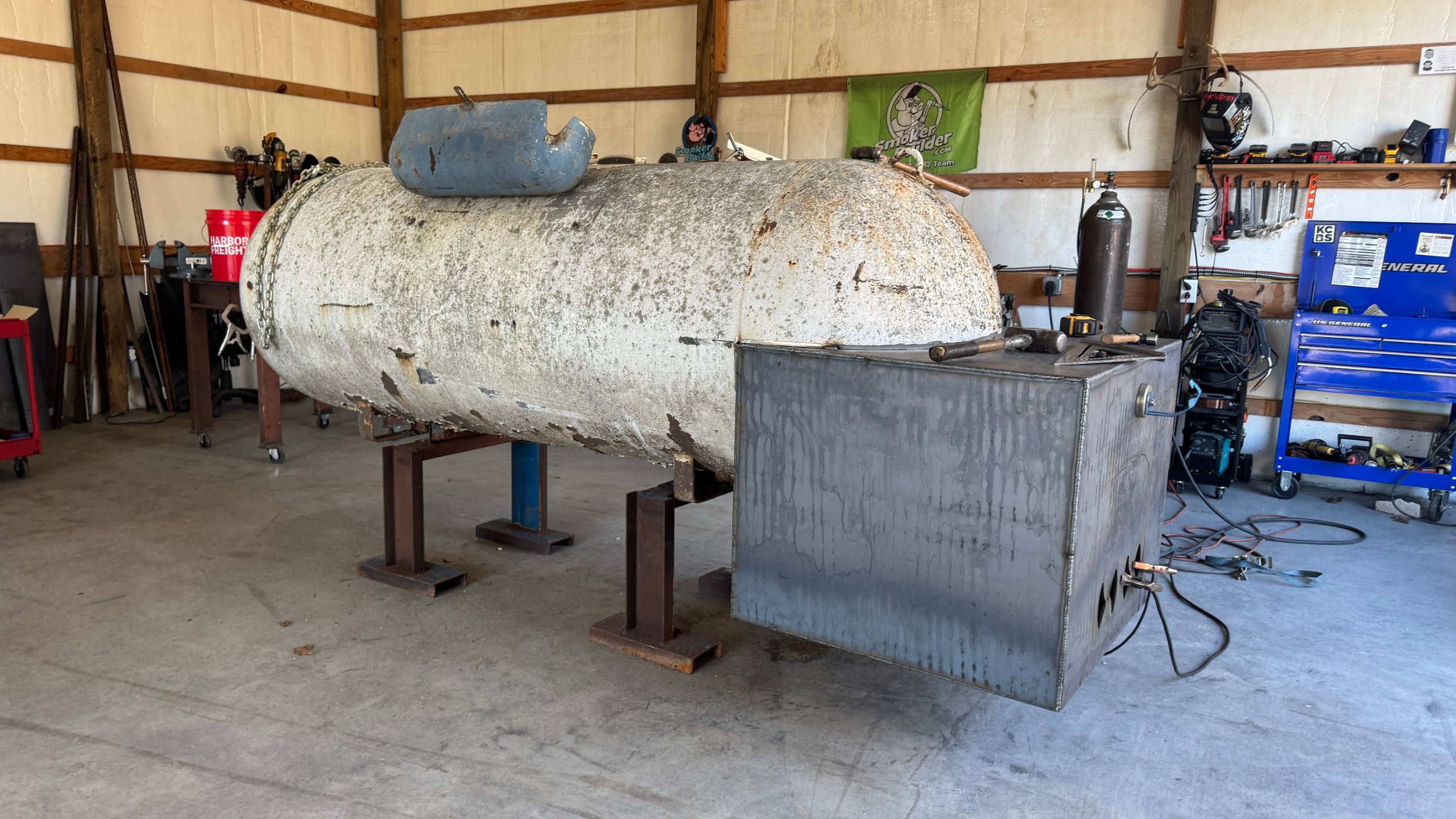
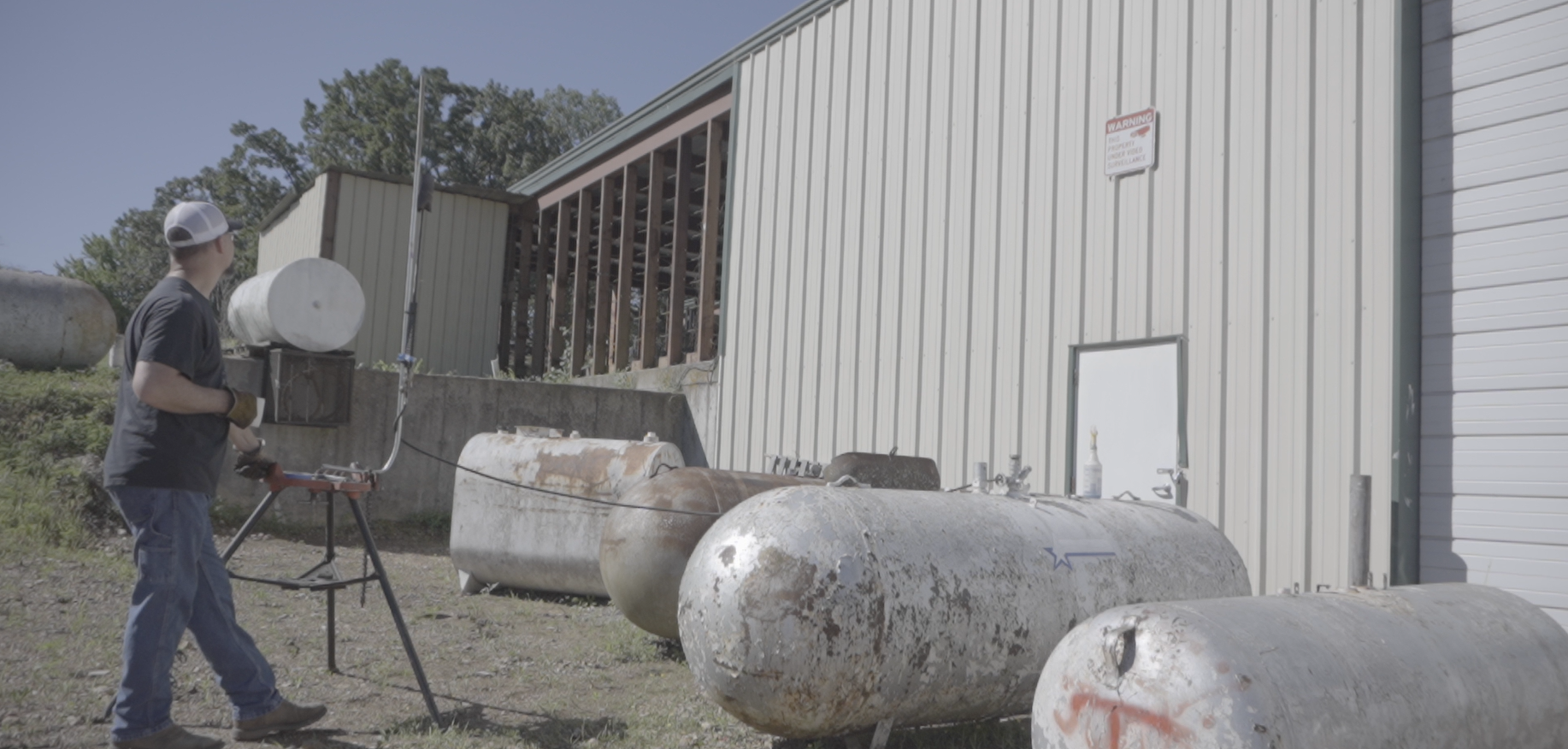

If you're looking for an offset smoker calculator, this is the math behind one, worked out by hand.
All you need is a tape, a calculator and the size of your tank. At the bottom there are two worked examples, a 250 gallon and a 500 gallon propane tank offset, every step shown.
And don't get stressed out about nailing a number exactly. Every one of these is a range. You just have to land in it.
The order you size it in
The cook chamber is the reference. Everything else hangs off it.
- Cook chamber volume. The tank you picked sets this.
- Firebox. A fraction of the chamber volume.
- Throat. Sized off the firebox.
- Stack. Diameter by gallon size, length by chamber length.
- Collector box. Sized off the stack.
- Baffle gap, if you're building a reverse flow or a scoop. Sized off the throat.
Here's the plain why. The chamber is the room you're heating. The firebox has to make enough heat and air for that room. The throat lets it in. The stack pulls it through. The collector is a clean transition from the chamber into the stack. And on a reverse flow, the baffle gap is what evens out the cook. Each step needs the one before it.
These are field-proven numbers, not physics formulas. They come from building pits, and they hold up from about 80 to 1,200 gallons.
Step 1: cook chamber volume
Gallons × 231 = cubic inches.
A 250 gallon tank is 57,750 cubic inches. A 500 is 115,500.
Gallons don't tell you how much meat fits, that's grate area. But gallons are what you size the firebox and stack to.
Step 2: firebox size
The reference is a firebox that's 30% of the cook chamber volume. That's dead center.
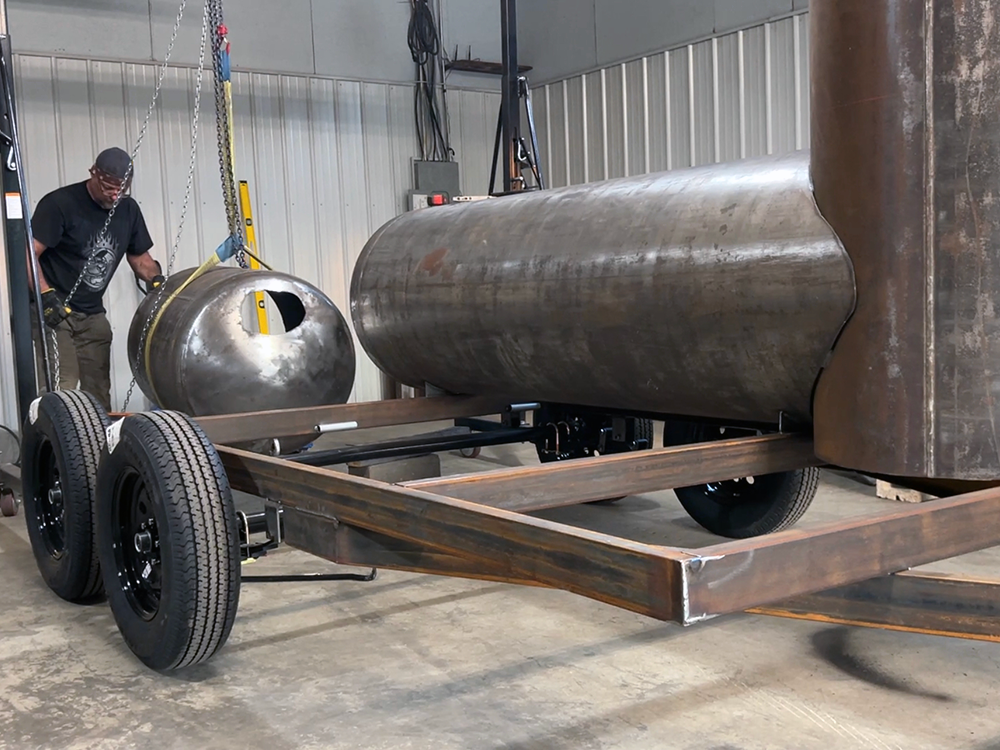
To see how your firebox compares, I use what I call the D-score. It's a little number divided by a big number:
D = 100 × (firebox volume ÷ (0.30 × cook chamber volume))
If that says 100, it's exactly the volume you need. Here's how to read it on an offset:
| D-score | What it means |
|---|---|
| 83 to 117 | Best practice |
| 70 to 82 | Needs support |
| 55 to 69 | Hard mode |
| Under 55 | Too small |
| Over 117 | Bigger than it needs to be |
A reverse flow firebox runs a little richer, about 103 to 115, centered around 107.
What "25%," "30%" and "a third" really mean. You'll hear all three. They're the same rule said loose. 30% is the center, a D-score of 100. 25% is the bottom of the best practice band. A third is up near the top. So a best practice firebox is roughly 25% to 35% of the chamber volume. Do the math and use your real number.
For a square firebox, the volume is the inside length × width × height. Divide by 231 if it's easier to picture it in gallons.
Step 3: throat size
The throat is the opening between the firebox and the cook chamber.
Throat area (square inches) = firebox volume (cubic inches) × 0.008
The throat follows the firebox you build. The chamber still drives it, because the firebox was sized off the chamber. But if you build the firebox bigger than the reference, the throat gets bigger with it.
Size it up, never down. There is no such thing as too large of a throat in a system designed for balance. The only limit is what physically fits on the end of the chamber.
The throat isn't supposed to be the choke point. It's built to let the air in slow. The restriction belongs at the baffle gap on a reverse flow, or the stack damper on an offset, not the throat.
More on the throat and the scoop: What Kind Of Baffle Should I Use For An Offset Smoker?
Step 4: stack size
Diameter and length are two separate answers. Diameter is how wide. Length is how tall. You don't size a stack by volume.
Diameter, by gallon size:
| Cook chamber | Stack diameter |
|---|---|
| About 80 to 175 gallon | 5" |
| 175 to 330 gallon | 6" |
| 330 to 750 gallon | 8" |
| 750 to 1,200 gallon | 10" |
Length: at least half the cook chamber length or 33", whichever is longer. No more than the full chamber length.
Step 5: collector box
The collector box is the transition from the round end of the chamber up into the stack.
- Height: at least the stack diameter, so it doesn't choke the flow.
- Width: wider than the stack. It can go as wide as the full chamber. As long as it's bigger than the smoke stack, that's what matters.
Step 6: baffle gap (reverse flow or scoop)
Size the gap by open area, not by a distance.
Gap open area = 0.50 to 1.25 × throat area. Start at 0.50.
That's an operating window and a starting point that's proven out in the field. It applies to a reverse flow baffle plate and to a scoop with a vertical baffle.
Where the firebox mounts
Find where your cooking grate will sit. We prefer it at the 3:00 door cut.
- On an offset, the firebox top lands at or above that line. It can go as high as flush with the inside top of the chamber.
- On a reverse flow, it sits at least 2" below it.
What doesn't change the sizing
Insulation. An insulated firebox gets sized exactly the same as one that isn't. Insulation changes how the fire runs, not how big the firebox should be.
Chamber shape. A tank, pipe, rolled cylinder, octagon or rectangle all cook the same. A flat-sided box burns a little more fuel in cold or wind. It doesn't change the sizing.
Worked example: 250 gallon offset
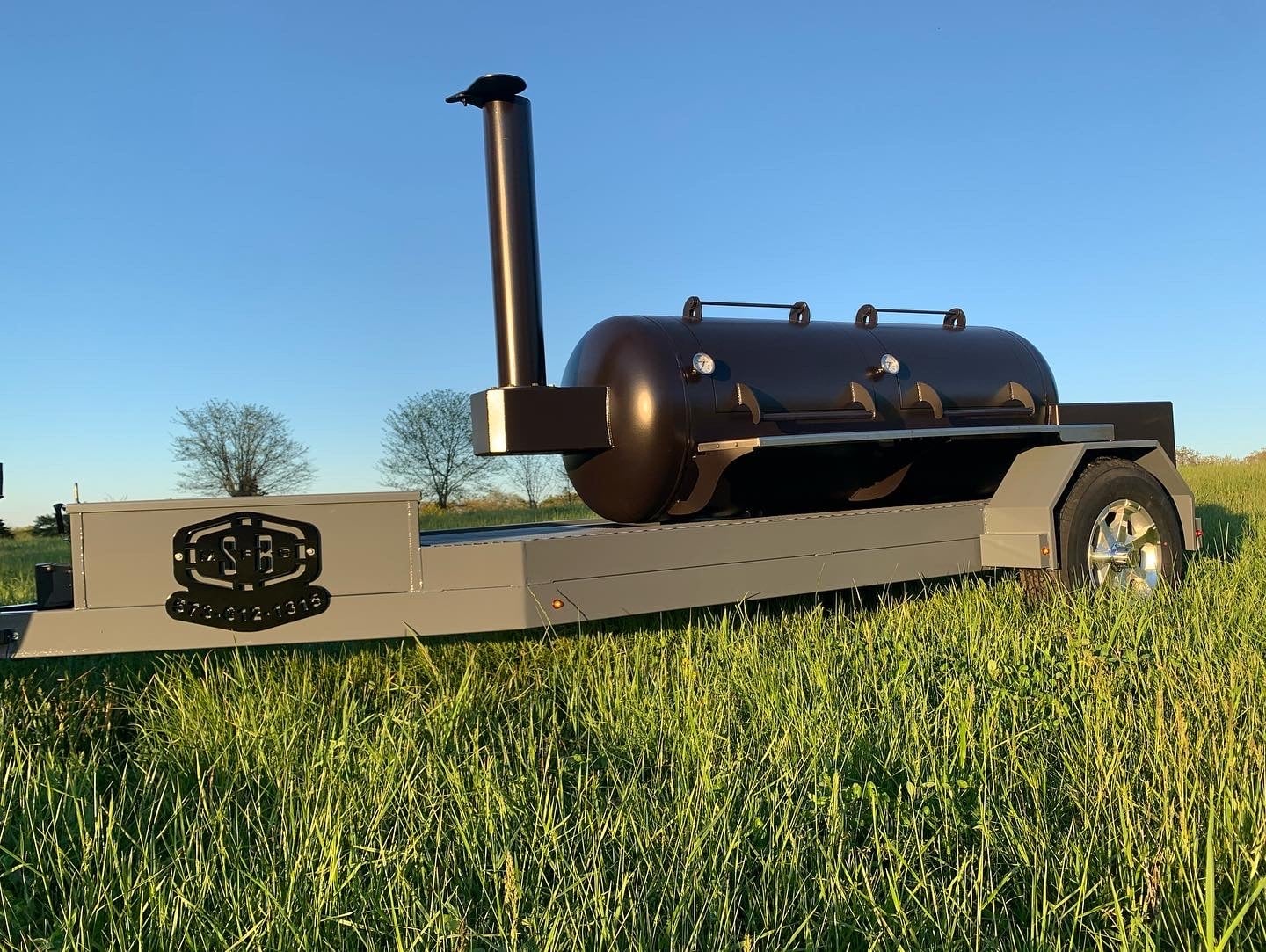
Tank: about 30" diameter × 87" long.
| Chamber volume | 250 × 231 = 57,750 cu in |
| Firebox | 0.30 × 57,750 = 17,325 cu in, about 75 gallons of firebox. Best practice range about 14,400 to 20,200 cu in. |
| Throat | With the firebox right at the reference: 17,325 × 0.008 = about 139 sq in |
| Stack | 6" diameter. Length at least half of 87", about 44", up to 87". |
| Collector | At least 6" tall, wider than 6" |
| Baffle gap (reverse flow) | Start at 0.50 × 139 = about 69 sq in. Window up to about 173 sq in. |
Worked example: 500 gallon offset
Tank: about 37" to 38" diameter × 120" long, tip to tip.
| Chamber volume | 500 × 231 = 115,500 cu in |
| Firebox | 0.30 × 115,500 = 34,650 cu in, about 150 gallons of firebox. Best practice range about 28,900 to 40,400 cu in. |
| Throat | With the firebox right at the reference: 34,650 × 0.008 = about 277 sq in |
| Stack | 8" diameter. Length at least half of 120", so 60", up to 120". My own 500 runs an 89" stack. |
| Collector | At least 8" tall, wider than 8" |
| Baffle gap (reverse flow) | Start at 0.50 × 277 = about 139 sq in. Window up to about 347 sq in. |
How that compares to my 500 gallon plan. The firebox on that plan is 37,612 cubic inches, a D-score of about 108, a little above the reference. So its throat is 37,612 × 0.008 = about 301 sq in, and its baffle gap window runs about 150 to 376 sq in. Both throats are right. Same rule, different firebox. The throat follows the firebox you build.
Round to numbers you can actually cut. Landing in the range is what matters.
Where to go from here
If you haven't picked a design yet, start with Smoker Designs. Once your numbers are worked out, here's the order I build it in: How to Build a Smoker.
If you want help checking your numbers, bring them to the live Q&A I do every Wednesday night at 7pm Central inside SmokerBuilderU.
Join SmokerBuilderU
If you'd rather skip the math, every plan set I've drawn already has it done. Fully dimensioned, ready to download at smokerplans.net.
Browse smoker plans
PS. Do the firebox first. Everything after it falls out of that number.
Questions builders ask
How big should the firebox be on an offset smoker?
About 30% of the cook chamber volume is dead center. The best practice range is roughly 25% to 35%. On a 250 gallon that's about 75 gallons of firebox, and on a 500 about 150.
How do you size the throat on an offset smoker?
Throat area in square inches = firebox volume in cubic inches × 0.008. Size it up, never down. On a 500 gallon with the firebox right at the 30% reference, that comes out to about 277 square inches. Build a bigger firebox and the throat gets bigger with it.
What size smoke stack do I need?
Diameter goes by gallon size: 5" for about 80 to 175 gallons, 6" for 175 to 330, 8" for 330 to 750, and 10" for 750 to 1,200. Length is at least half the chamber length or 33", whichever is longer, and no more than the full chamber length.
Does insulating the firebox change its size?
No. An insulated firebox is sized the same as an uninsulated one. Insulation changes how the fire runs, not the size.
Is there an offset smoker calculator?
You don't need one for this. With your tank's gallons, a tape and a regular calculator, the steps on this page size the firebox, throat, stack, collector and baffle gap by hand.
