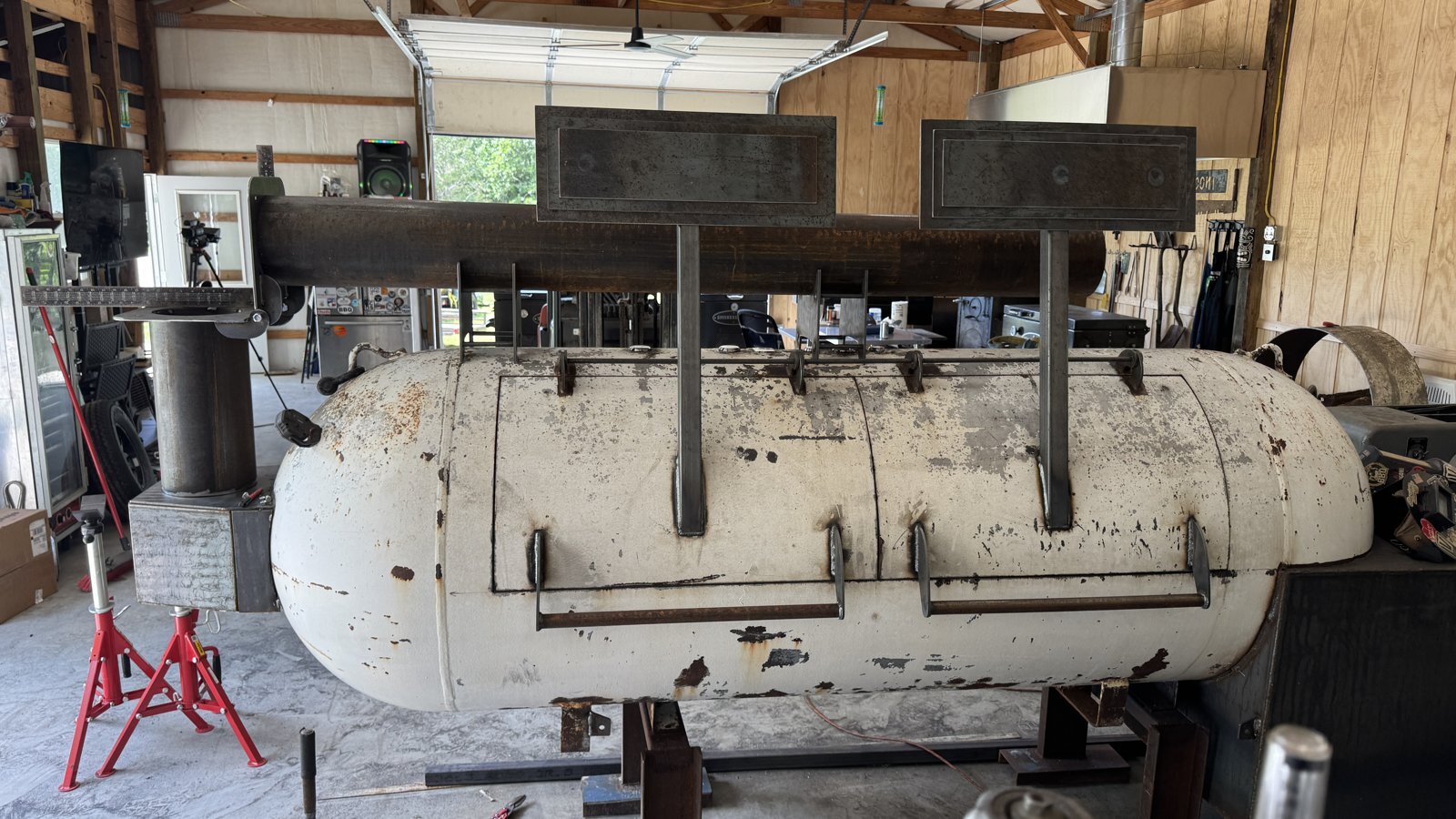
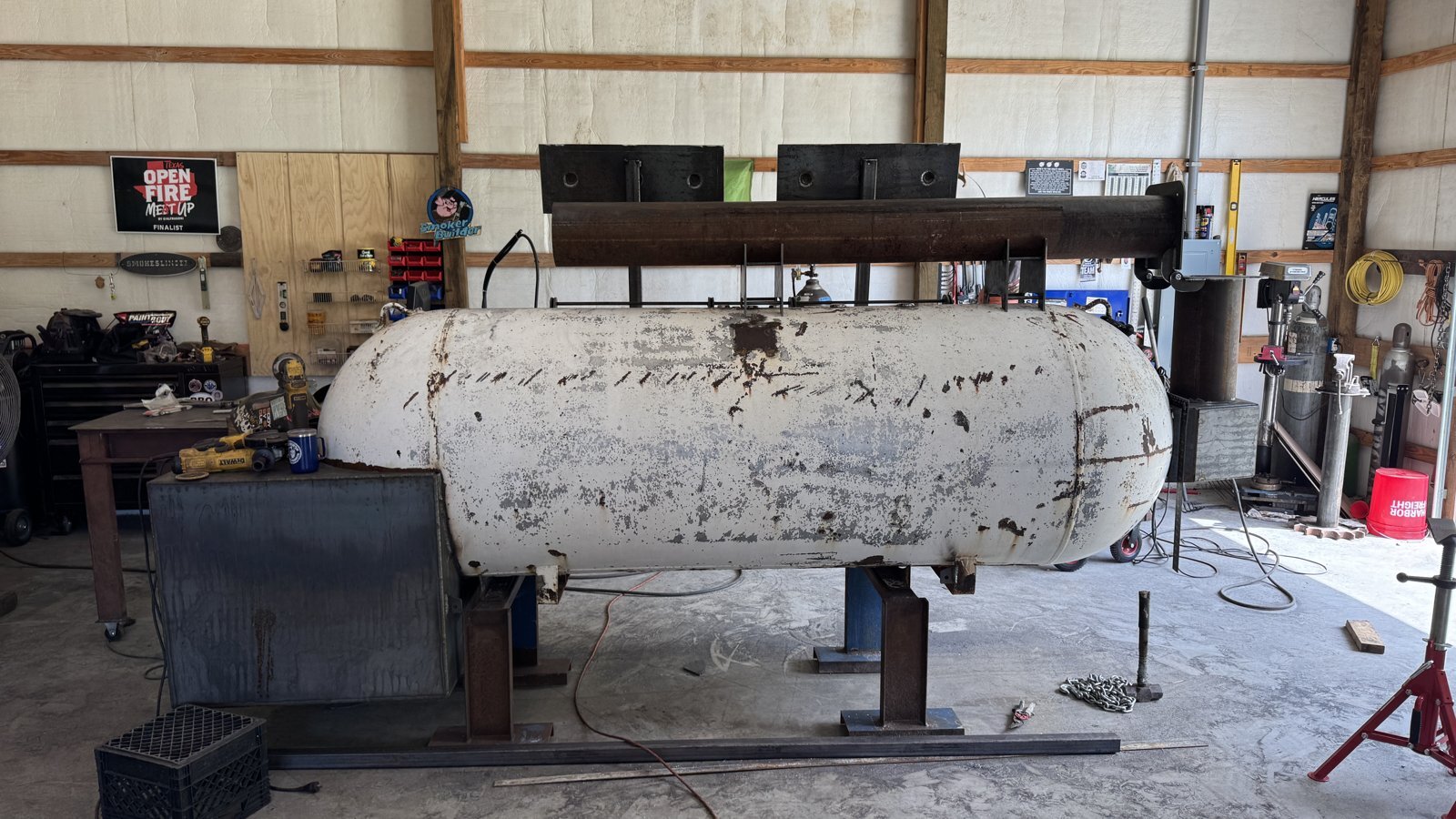

On a 250 or a 500 gallon propane tank offset, the firebox is the part guys second-guess the most. How big. What shape. How thick. How high to hang it.
Here's how I answer each of those, in the order they come up when you build one.
The short version: size it by volume, about 30% of the cook chamber. Build whatever shape is easiest for you to build true. Use 1/4" plate. Set the mount height based on where your cooking grate sits, not necessarily the middle of the tank.
Rather start from a drawing with the firebox already sized and laid out? My plan sets are drawn by cook chamber type and size. Find the plan for your cook chamber
How big should the firebox be for my tank?
About 30% of the cook chamber's volume. That's the target.
On an offset, anywhere from about 25% to 35% is a good firebox. A reverse flow runs a little bigger and a little tighter, about 31% to 34%.
| Cook chamber | Aim for | Offset range | Reverse flow range |
|---|---|---|---|
| 250 gallon | 75 gal | 62 to 88 gal | 77 to 86 gal |
| 500 gallon | 150 gal | 125 to 176 gal | 155 to 173 gal |
The full sizing order, firebox through stack, with a 250 and a 500 worked step by step, is here: Offset Smoker Sizing.
How big should the opening between the firebox and cook chamber be?
That opening is the throat. Its area is the firebox volume in cubic inches times 0.008, and the answer is square inches.
The throat is sized to pass the full volume of air without speeding it up. It's not supposed to be the choke point. So if you're between sizes, size up. Never down.
The opening goes at the top of the firebox. Its shape depends on how much room you have to work with where the firebox meets the cook chamber. Figure the area you need first, then fit it into the space you have. That might be a half-moon, a slot or a rectangle. Any shape works as long as you hit the area. Never go smaller.
Watch your kerf. A plasma cut that's 1/8" wide tends to leave you about a 1/4" gap once it's fit up. Pick one shim offset and use it on every cut on that tank so the gaps come out the same.
The worked throat numbers for a 250 and a 500 are in the sizing article.
Does the firebox have to be round, or can I build it square?
Either one. Shape doesn't change the sizing.
The firebox is sized by volume, so any shape that hits the target volume is right. Pick the shape that's easiest for you to build true.
Plate lets you build it exactly square. A round section cut from pipe or a tank works too.
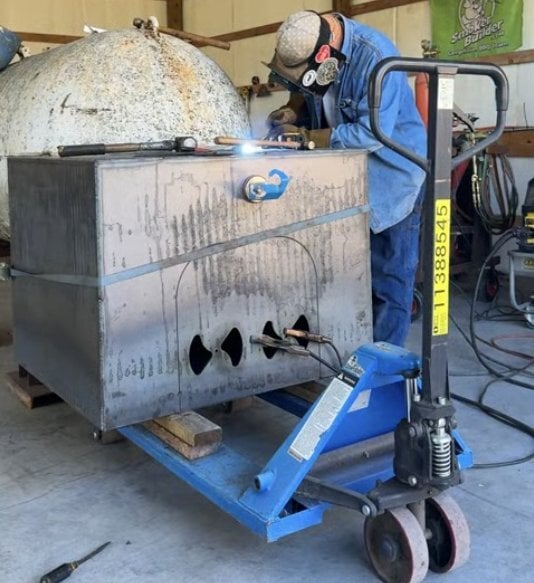
How thick does the firebox steel need to be?
1/4" plate. That's my default, because it stands up.
What thicker steel buys you is heat hold. Thin stock comes up to temp fast and loses it fast. Thick stock holds it longer. A well-built 1/4" pit cooks as good as a 5/8" one.
It also adds up on the trailer. 1/4" plate runs about 10.25 lb per square foot. 3/8" is about 15.
If you do go thinner, stiffen it with geometry instead of weight. Flat bar, 1.5" by 1/8" or 1.5" by 1/4", set on edge as ribs and stitch-welded on, not welded solid.
Should I insulate the firebox?
Usually it's overkill. I rarely build one insulated.
It won't save you much wood. It burns about the same.
What it does is hold a lot more heat in the box. A pit gets even temps by moving enough air through it. The more heat the box holds onto, the smaller the fire you end up running, and the less air moves through the pit. On a balanced pit, that works against you.
Where it earns its keep is cooking in the rain or real cold. Water or cold air on the firebox steel pulls heat away before it ever gets to the cook chamber. It also keeps the outside of the box cooler to the touch and saves the paint. And you can always add it later.
It doesn't change the sizing. Same 30% target, insulated or not.
If you build one, here's how it goes together:
- Both walls in 1/4" plate. Inner and outer. You don't need to go heavier.
- Ribs between the skins, stitch-welded.
- Mineral wool rigid board in the cavity, about 1.5" thick, rated around 2100°F. It cuts with a utility knife. Regular fiberglass batt melts, and loose fill slumps and settles.
Expect the inner wall to warp some over time. The outer wall should hold its shape.
How high do I mount the firebox on the cook chamber?
Find where your cooking grate sits. I like the grate at the 3:00 door cut. Measure from that line, not necessarily the middle of the tank.
- Offset: the top of the firebox lands at or above the grate, and as high as flush with the inside top of the chamber. Where you land in that band is your call. An offset sends the air up first, so the height isn't critical for airflow. Throat room, ground clearance on the trailer (keep at least 8") and looks decide it.
- Reverse flow: the top of the firebox sits at least 2" below the grate. The baffle plate sits at or above the firebox top, and the grate needs at least 2" over the plate, so the firebox has to sit lower.
When you fit it up:
- Use a string line to work around a tank that isn't perfectly straight or round. No two tanks come out the same.
- Keep a round firebox clocked and level with a laser, and keep checking it.
- Three tacks minimum so it can't hinge on you.
- Tack it, check it, then weld it. Never weld before the alignment is right.
- Keep your attachments off the tank's factory weld seams.
- Close up a gap a little at a time and re-check. Small corrections beat one big recut.
Where do the air intakes go, and how big should they be?
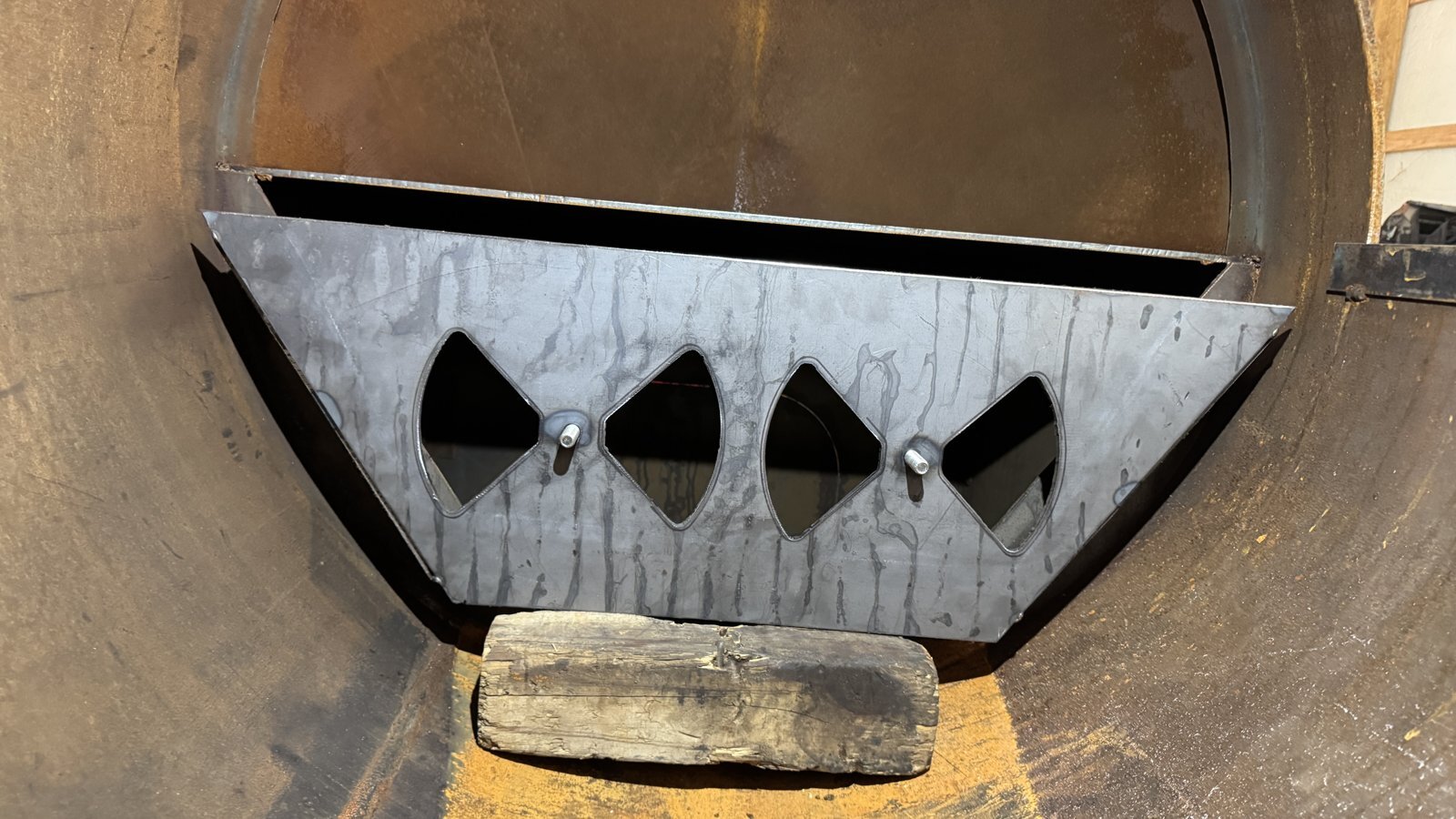
These days I prefer the intake in the firebox door, or using the door itself as the intake. That way air comes in from the end and runs straight under the log rack toward the throat.
Intakes on the side of the firebox work too, and they're simple to build. That's the way we used to do it, and it's what you'll see on a lot of my plans.
Keep it low. Raising the intake more than about 12 to 16 inches above the fire risks backdraft.
Size it at firebox volume in cubic inches times 0.003, and the answer is square inches of intake.
- 250 gallon chamber, 17,325 cu in firebox: about 52 sq in of intake
- 500 gallon chamber, 34,650 cu in firebox: about 104 sq in of intake
I like a pinwheel damper on the door. Cut it from 1/4" plate: center-mark it, scribe the circle, divide it into quadrants, cut the pie openings, clean off the dross and drill the center hole for the rod.
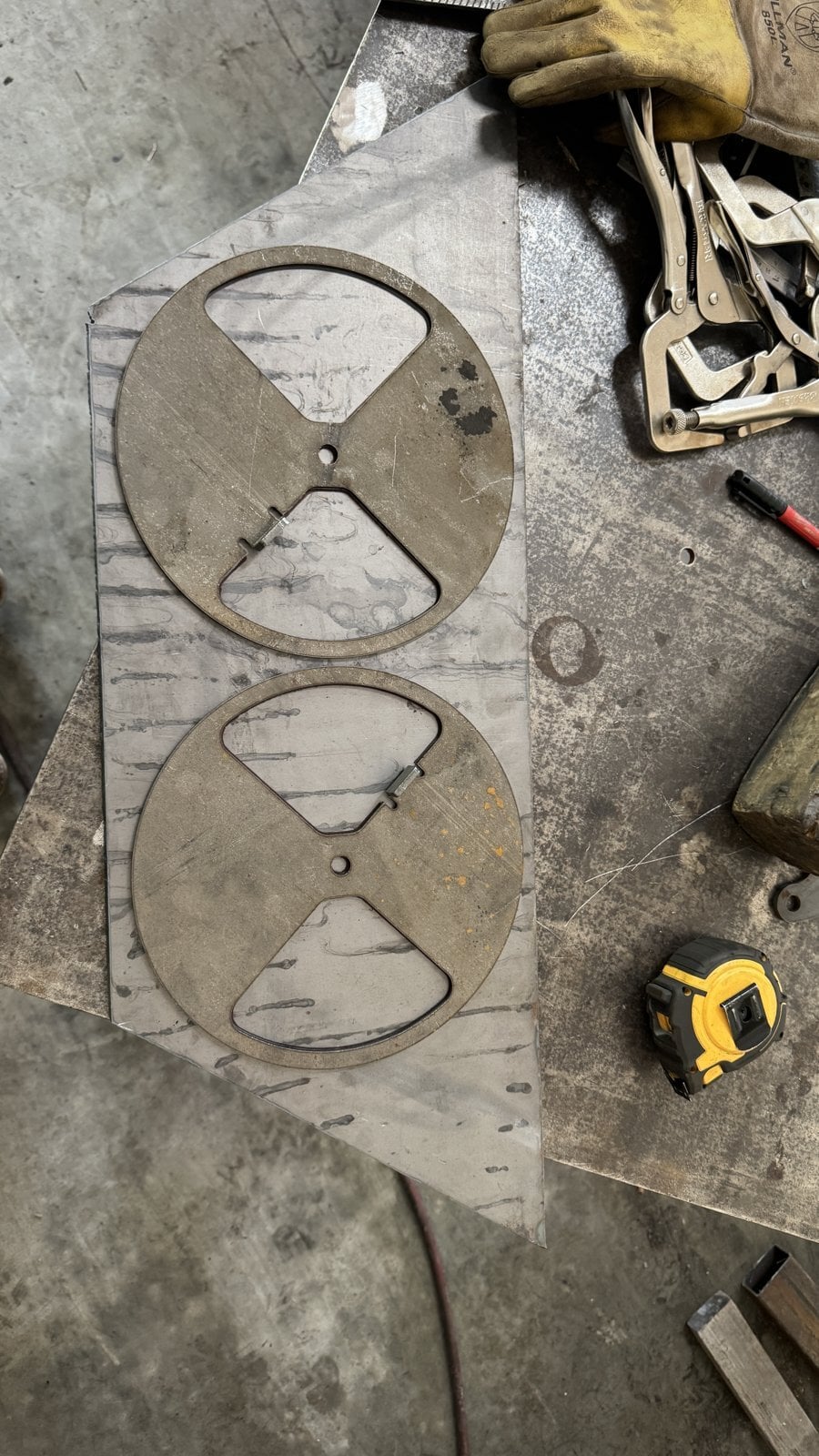
Set the log rack at least 4" off the floor of the box. I run mine 5 to 6" or more. Rack height controls how much ash rides up onto the food.
How do I build and hang the firebox door?
- Lay it out off the top-dead-center line, and check it square with 3-4-5.
- Cut it with the plasma dragged against a straight edge.
- Before the final tack, pull tension on the door side of the hinge to take the slop out of the pivot holes. Hand tension is fine. That keeps the door from sagging later. Tack the ends, then the middle, then split what's left.
- A 1/2" solid rod pin through a 1.5" by 1/8" strap makes a good hinge.
Where to go from here
The firebox sets the throat, and the throat sets the stack and collector. The whole order is here: Offset Smoker Sizing: Firebox, Throat, Stack. And if you're still deciding between an offset and a reverse flow: Smoker Designs.
If this is your first build, you can follow a full 500 gallon build inside SmokerBuilderU step by step, and bring your firebox questions to the live Q&A every Wednesday night at 7pm Central.
Join SmokerBuilderU
If you'd rather start from a drawing, every plan set I've drawn is at smokerplans.net, laid out by cook chamber type and size with the firebox already sized.
Find the plan for your cook chamber
PS. Tack, check, then weld. Every time.
Questions builders ask
How big should the firebox be on an offset smoker?
About 30% of the cook chamber volume, with a good range from about 25% to 35%. On a 250 gallon tank that's about 75 gallons of firebox, and 150 gallons on a 500.
How big should the firebox be on a reverse flow smoker?
A little bigger and tighter than an offset, about 31% to 34% of the cook chamber volume. That's roughly 77 to 86 gallons on a 250 and 155 to 173 gallons on a 500.
Can a smoker firebox be square?
Yes. The firebox is sized by volume, so square, rectangular or round all work as long as they hit the target volume. Build the shape that's easiest for you to build true.
How thick should a smoker firebox be?
1/4" plate is the default. Thicker steel holds heat longer but doesn't cook better, and it adds weight. 1/4" plate runs about 10.25 lb per square foot.
Should I insulate my smoker firebox?
Usually it's overkill. It won't save much wood, and it holds so much heat that it can cut down how much air moves through the pit. It helps if you cook in the rain or real cold. It doesn't change the firebox size. If you build one, use 1/4" plate for both walls and mineral wool rigid board rated around 2100°F, not fiberglass batt.
How high should the firebox be mounted?
Measure from the cooking grate. On an offset, the firebox top sits at or above the grate, up to flush with the inside top of the chamber. On a reverse flow, the firebox top sits at least 2" below the grate.
Where should the air intake be on a smoker firebox?
I prefer the intake in the firebox door, or using the door itself, so air runs straight under the log rack to the throat. Side intakes work too and are simple to build. Keep it low. Size it at firebox volume in cubic inches times 0.003 to get square inches of intake.